Redesigning Delivery Hero's Global Loyalty Program
Delivery Hero operates one of the largest delivery platforms globally, with millions of riders working across dozens of markets. To support rider engagement and retention, the platform runs a tier-based loyalty program where riders unlock benefits as they complete deliveries.
The program spans 70+ countries and 11 brands, making the loyalty program one of the key aspect to shape rider's motivation and retention across platforms.
However, research revealed that the product experience made it difficult for riders to clearly understand their tier progress, benefits, and what actions were required to reach the next level.
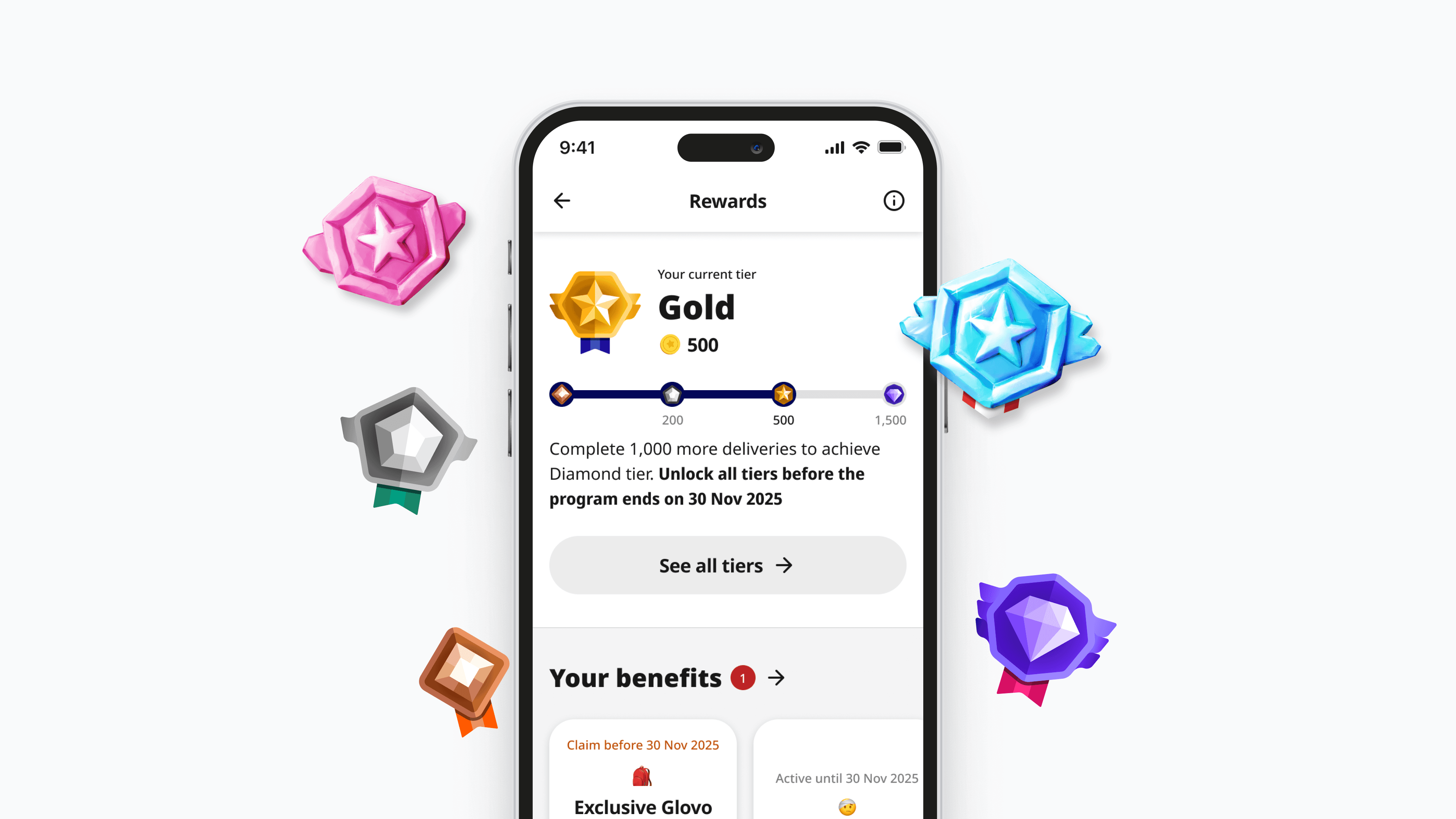
Company
Delivery Hero
Role
Lead Designer
Date
Late 2024 - Mid 2025
Platform
Mobile App
Evolution of the Loyalty Program
Before diving into the redesign, it's important to understand how the loyalty experience reached its current state. The system had gone through several iterations over the years.
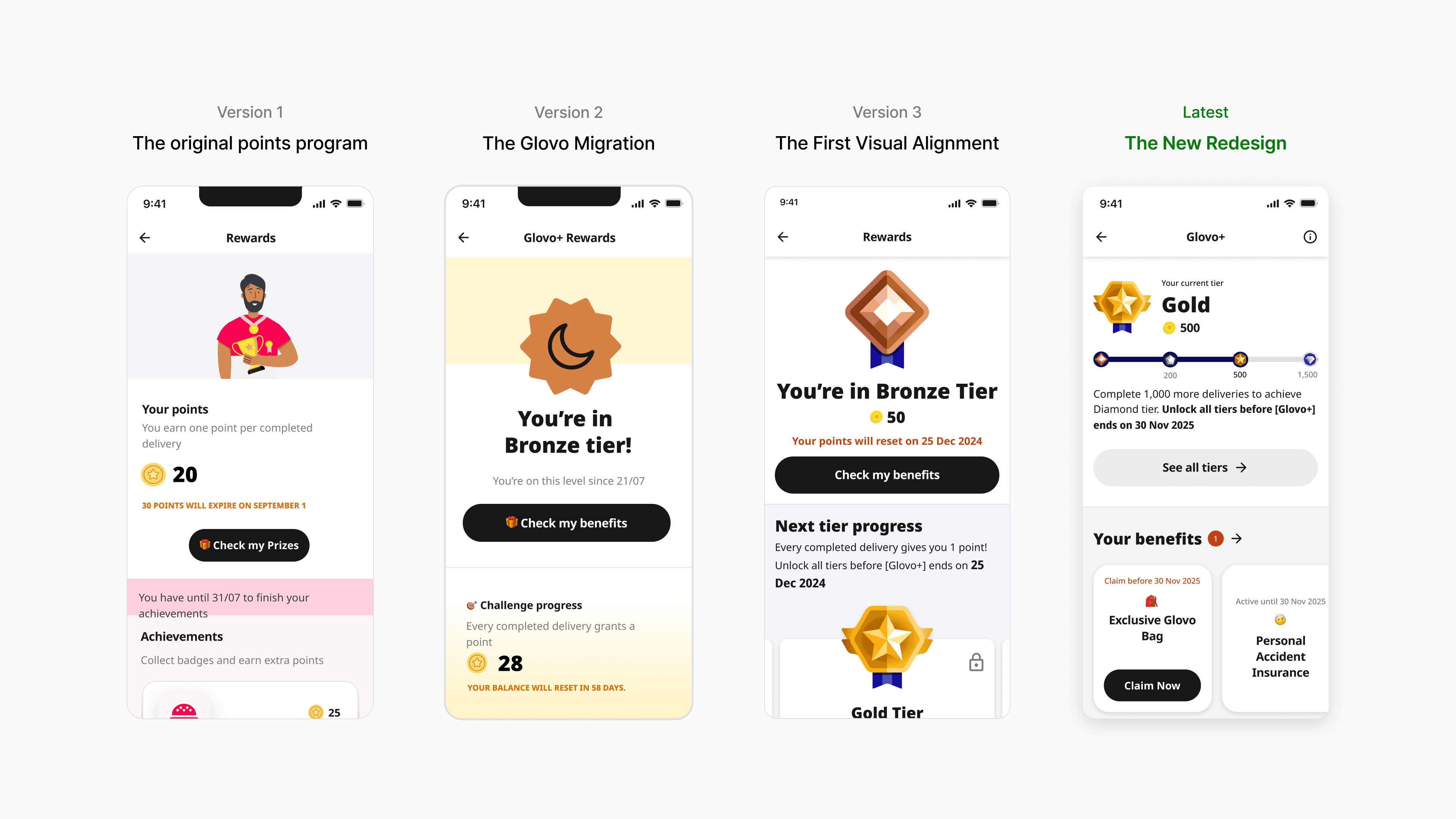
V1: The original points program
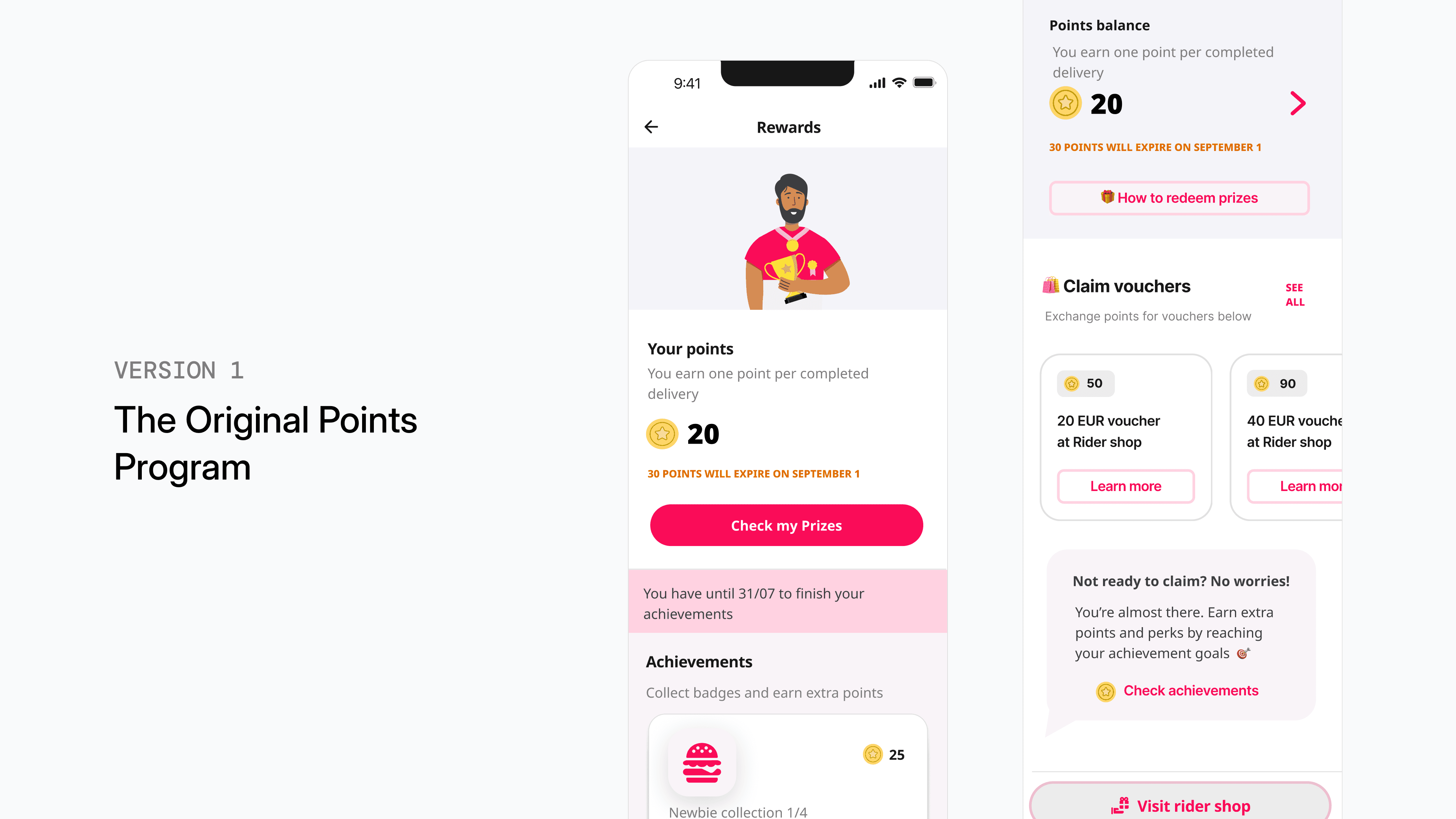
Delivery Hero initially operated a points-based loyalty system in several markets. Riders accumulated points through deliveries and could redeem them for benefits. While functional, the points model made it harder to communicate progress and motivation clearly.
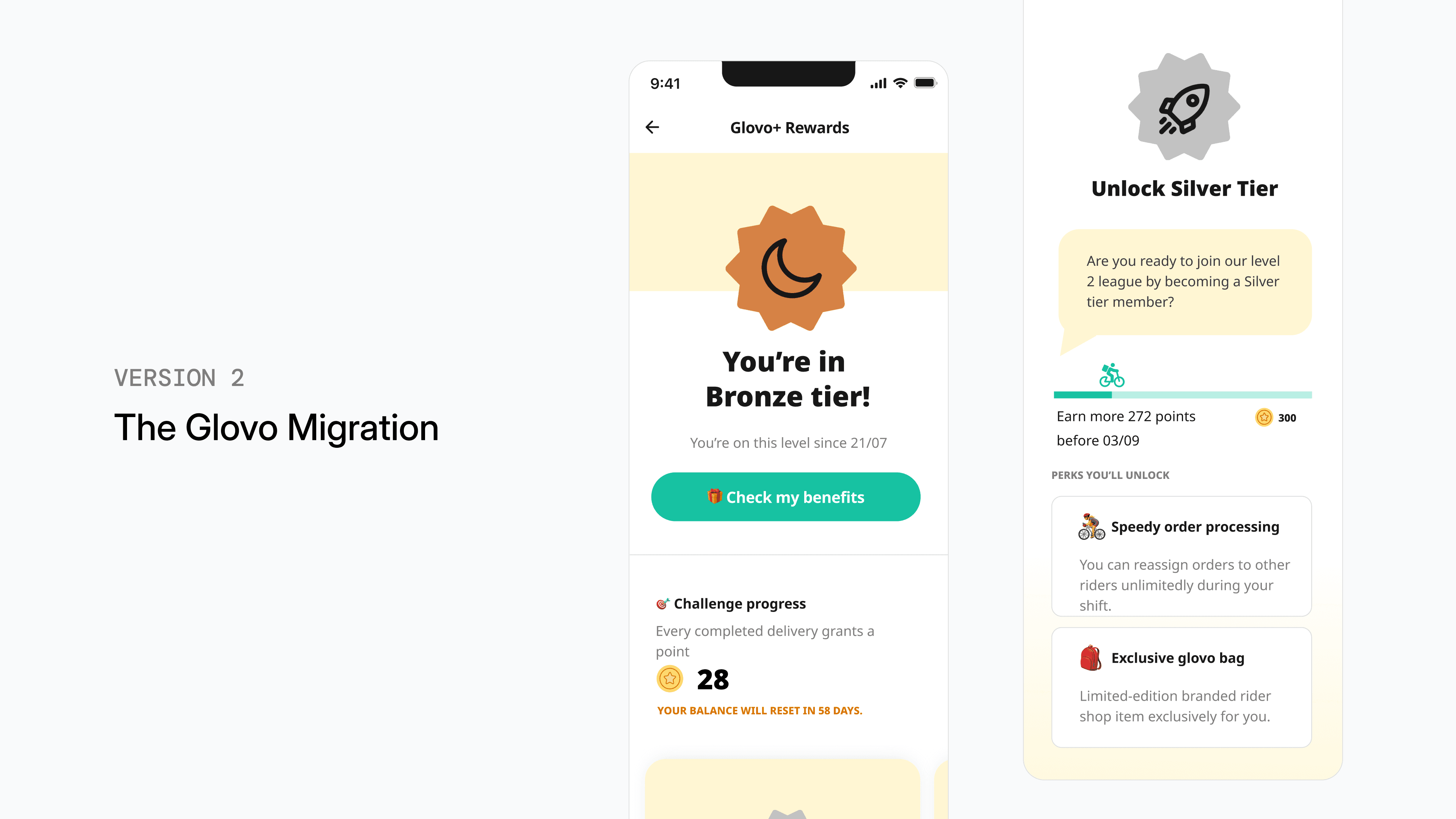
V2: The Glovo Migration
Following the Glovo integration in 2024, Delivery Hero adopted Glovo’s tier-based loyalty structure. The system introduced clearer progression: Bronze, Silver, Gold, to Diamond. Riders unlock benefits as they reach higher tiers. However, the UI was largely adopted as-is during the migration.
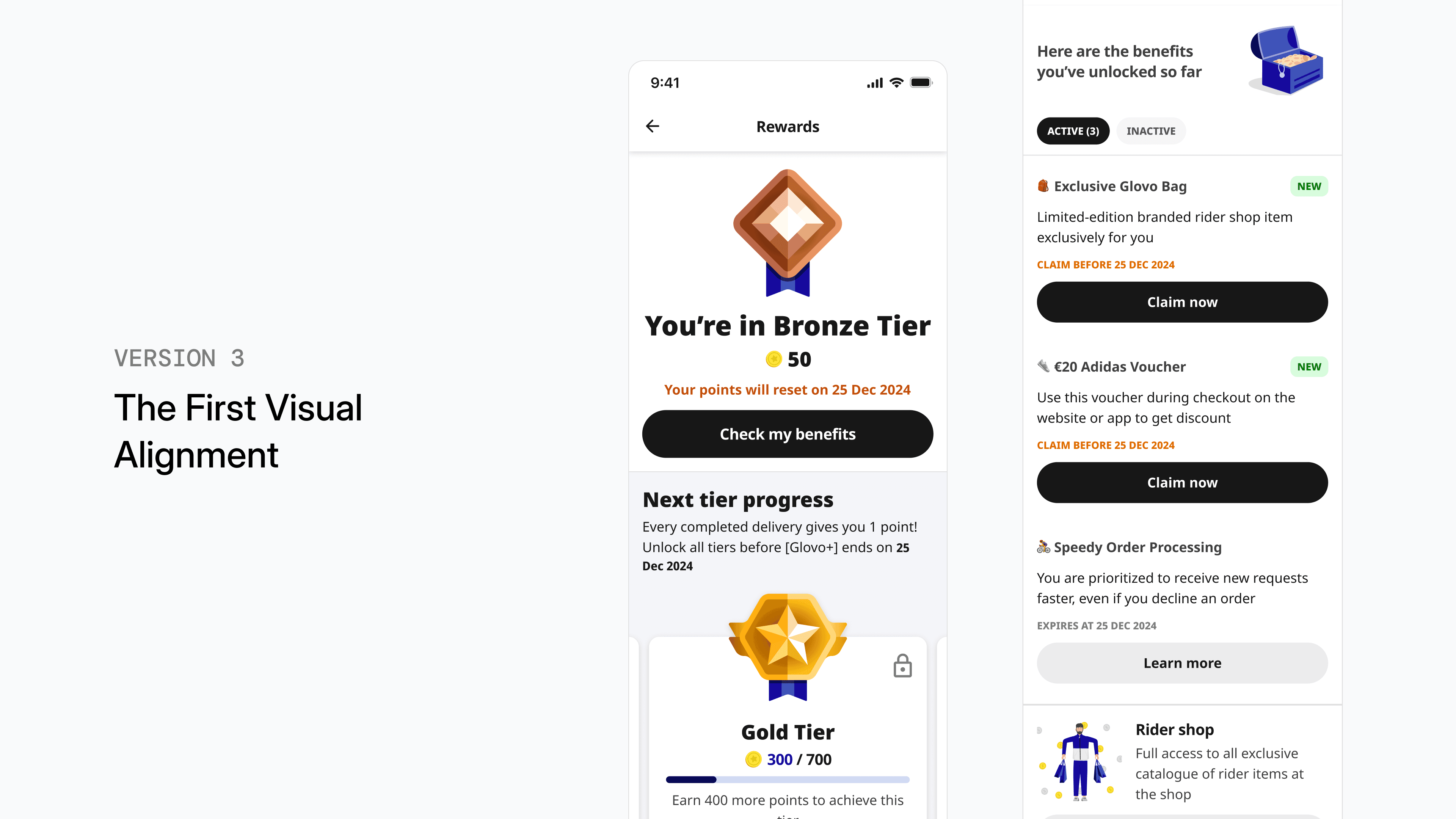
V3: A first visual alignment update
The first design update after migration was mostly cosmetic. Engineering capacity at the time was limited, so the focus was on:
Aligning the UI with Delivery Hero’s design system
Fixing some basic heuristics
Improving visual consistency
But structurally, the experience remained the same. This meant many of the underlying usability problems remained unsolved.
The Real Problem
Eventually, regional operations teams began raising repeated concerns and patterns of confusion from riders interacting with the program. These teams have direct contact with rider support and often see friction earlier than product analytics alone. The summary is that:
Common questions from riders included:
What tier am I currently in?
How far am I from the next tier?
Which benefits do I actually have right now?
Do I need to claim benefits or are they already active?
When exactly do these benefits expire?
These questions sound simple. But when riders cannot answer them quickly, the motivational effect of the entire loyalty system weakens.
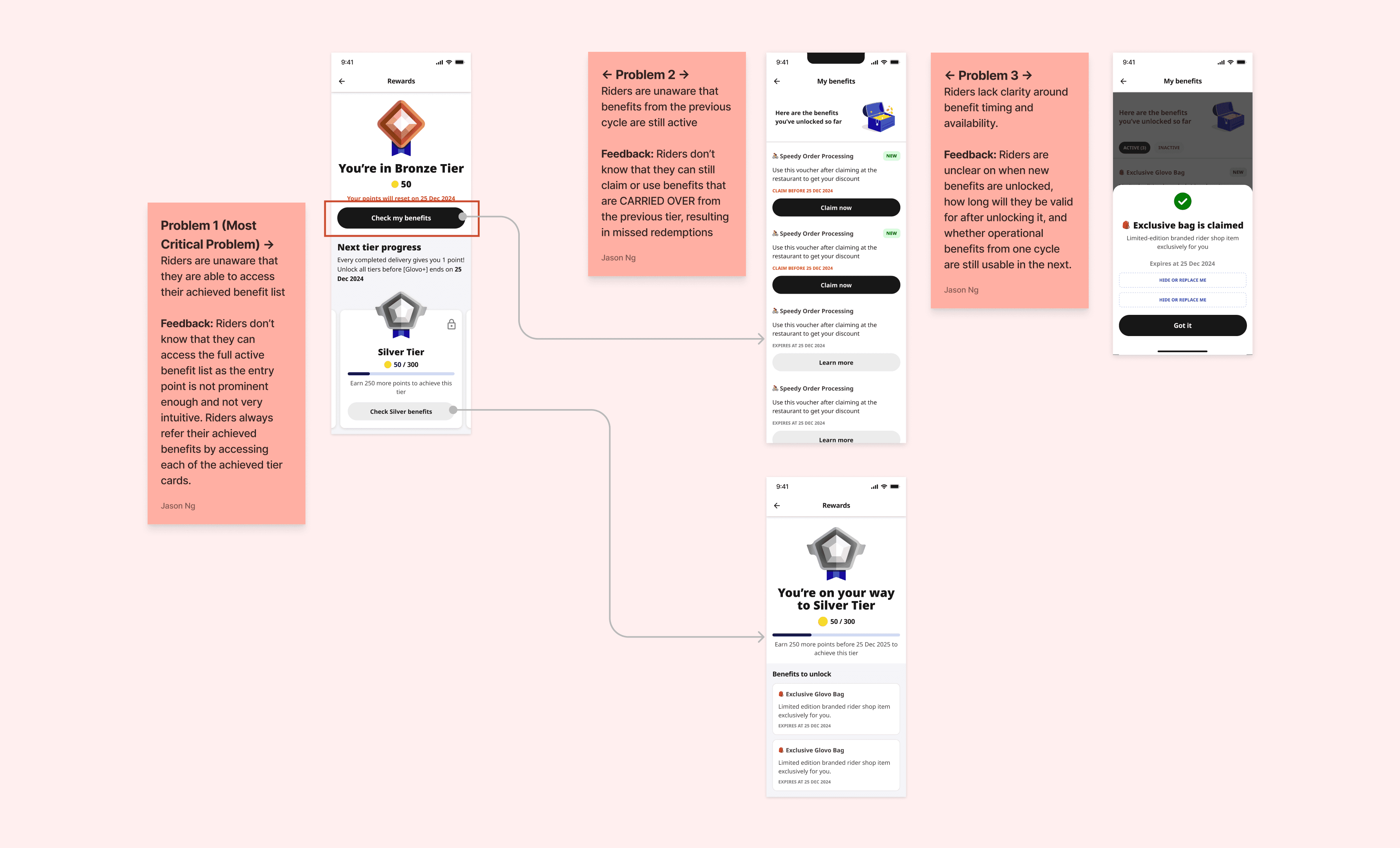
Our regional feedbacks findings
Validating the Problem
Rather than jumping straight into redesigning the UI after learning these problems from the regional team, we tried to gather more data points so that we can breakdown what was actually happening. We looked at the problem from several angles:
Most riders never explored beyond the loyalty home screen
Interaction analytics data showed that riders were rarely exploring deeper parts of the loyalty experience, such as viewing benefit details or checking tier progress. Most interactions stopped at the surface level of the loyalty screen, suggesting that riders were not fully engaging with the system.
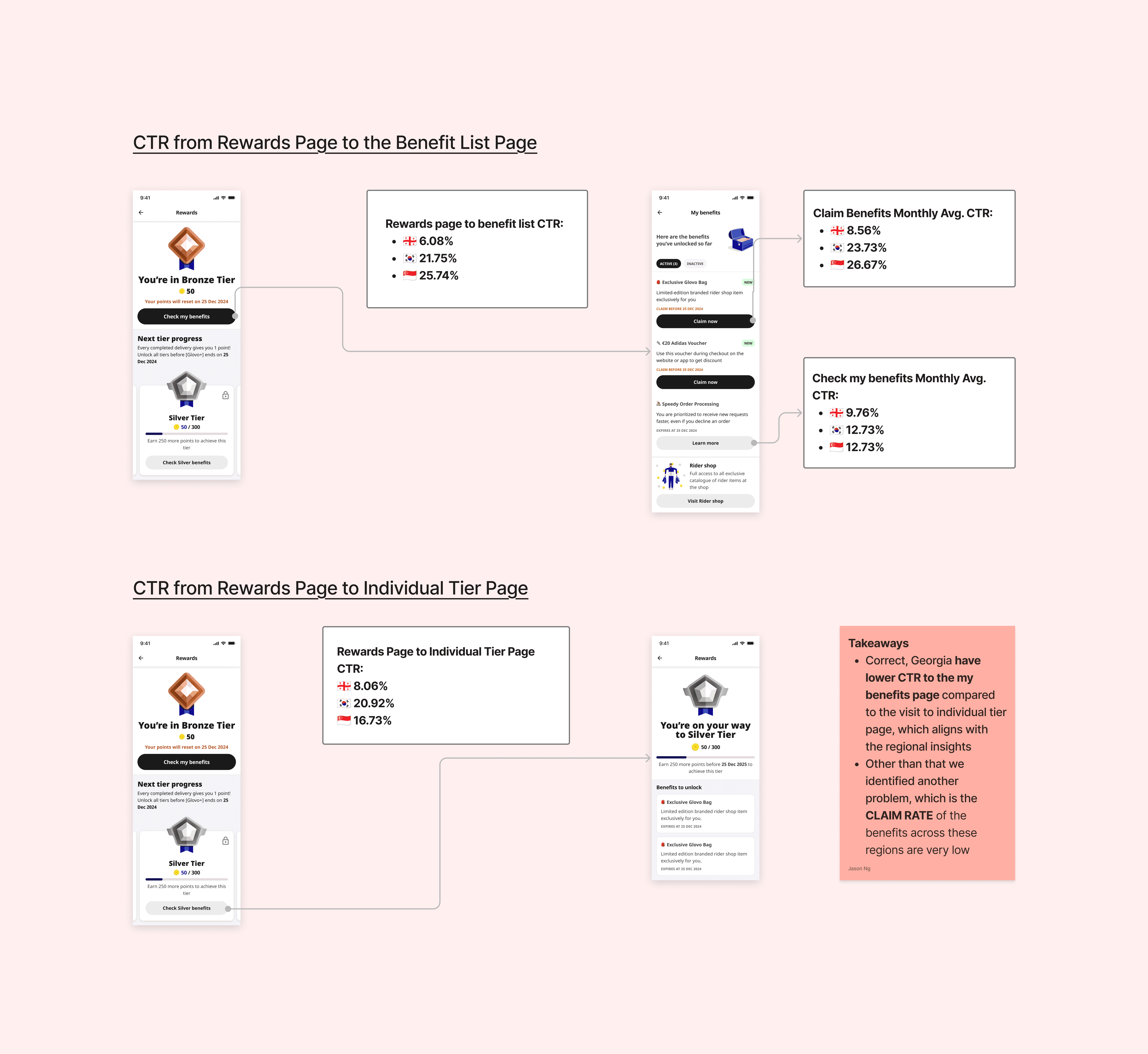
Data analysis results in several large regions
Riders opened the loyalty page but struggled to make sense of it
We also looked at behavioral patterns and session recordings. Watching riders interact with the loyalty pages made something clear very quickly. Riders weren’t ignoring the feature. They were trying to understand it, but often had to scan multiple areas of the interface before finding the information they needed, but majority of them dropped off before they could find what wanted. This suggested the issue was not lack of interest, but information clarity.
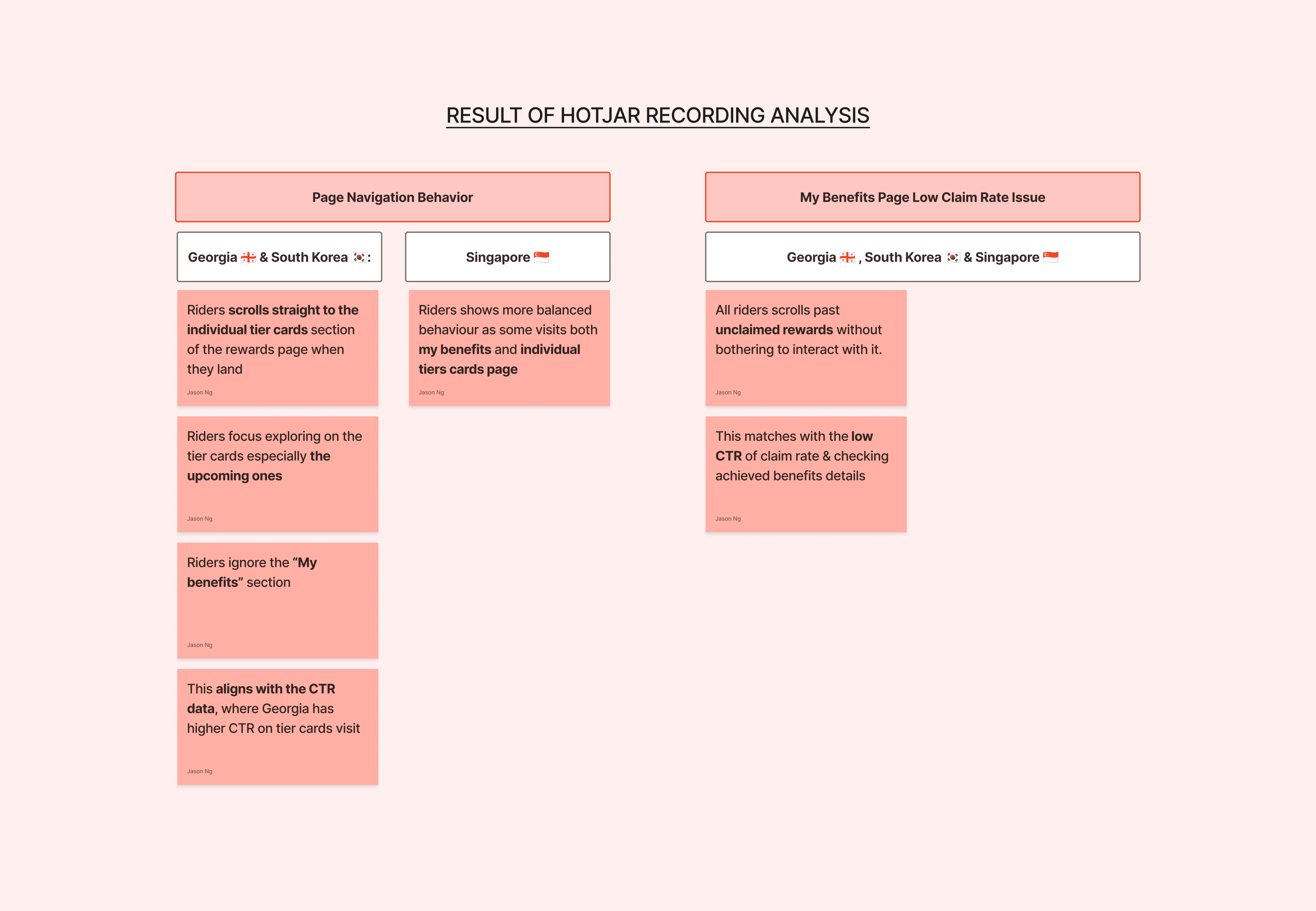
Affinity Mapping from App Recording Analysis
Some riders still doesn't understand the program mechanics
In the multi-market surveys, while most riders recognized the value of the program, many struggled to clearly understand tier progression, benefit eligibility, and what actions were required to reach the next tier. The results indicated that improving benefit visibility and progress clarity would play a key role in increasing rider motivation and engagement with the program.
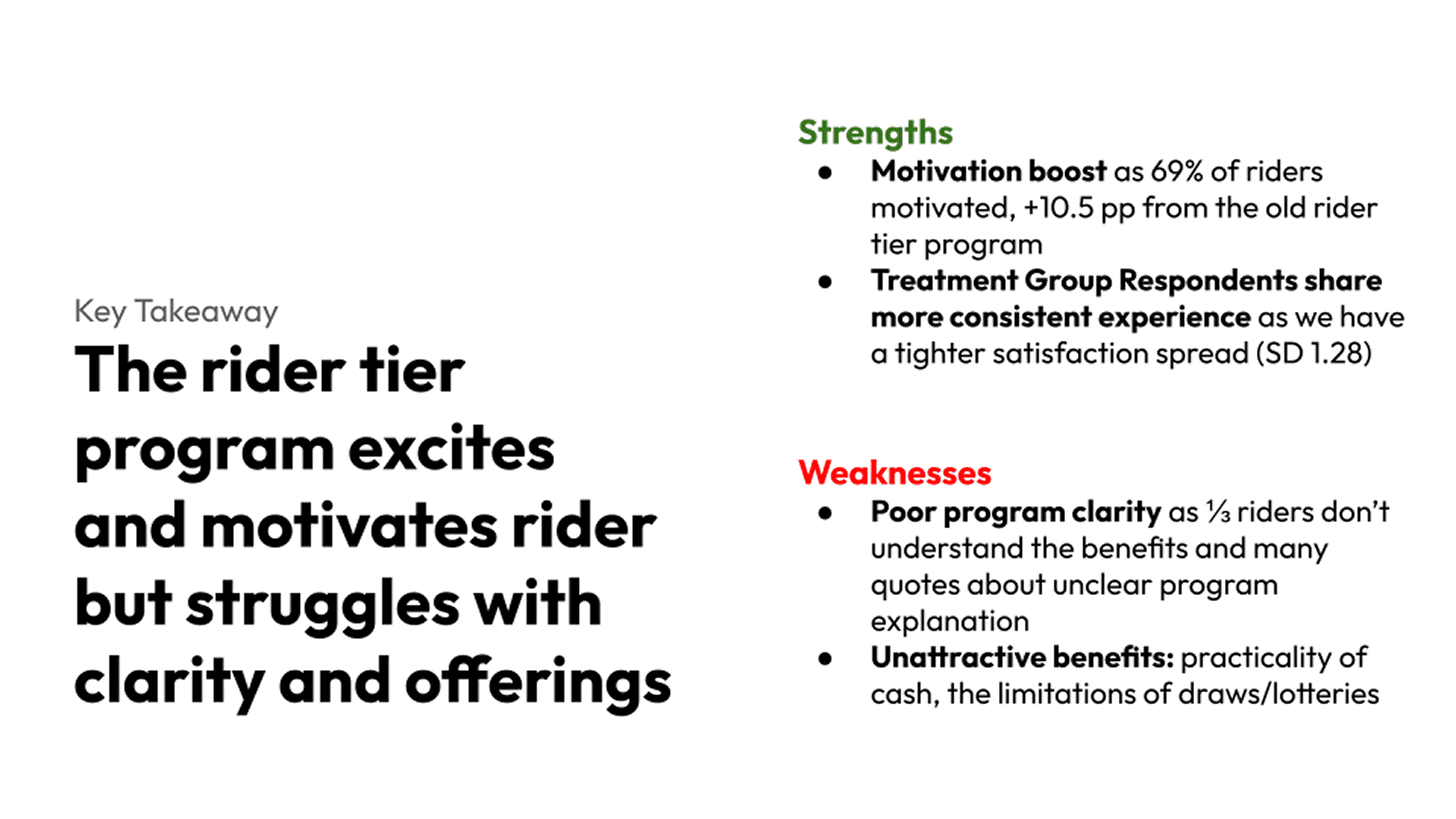
First Iterations
Based on the insights gathered across analytics, rider surveys, and behavioral recordings, we introduced the first iteration of improvements to the loyalty experience.
IMPROVEMENT 1
Progression should always be visible upfront
Riders previously struggled to understand where are they throughout the progress since we’re only highlighting their upcoming next progress. The overall page wasn’t really utilized properly.
We introduced clearer progress indicator upfront, showing the numbers of deliveries completed combined with how many remained to unlock all of the next level. This allow riders to immediately understand in a glance where they currently are in the progress.
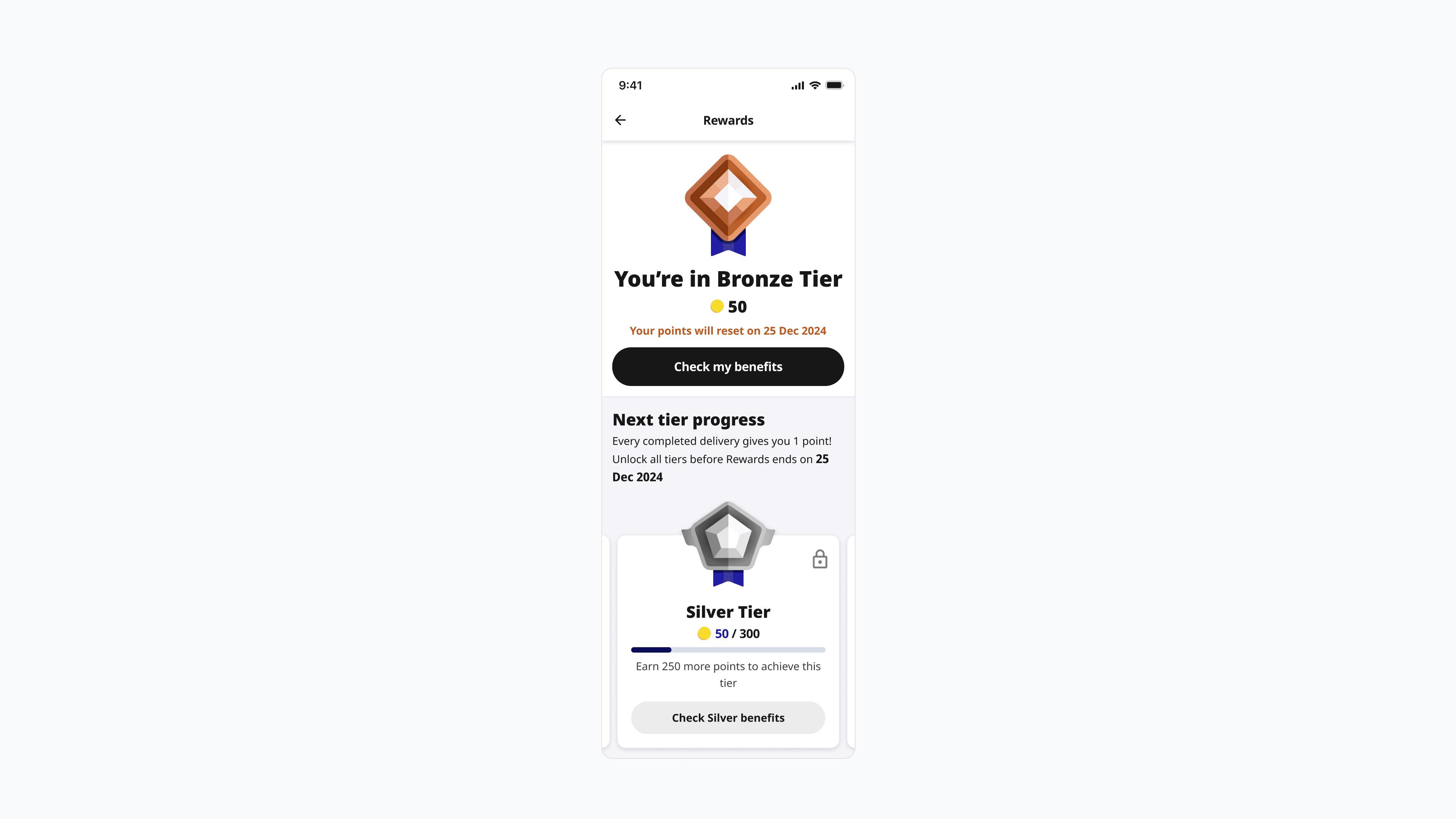
Before (V3)
Improved Designs
Showcase benefits upfront
Benefits that riders achieved were previously buried within another page. This was one of the major problem raised by the regions and is also evident by data of low page visit to the benefit list page & low claim rates as the entry point to that page is only through a single button that riders didn’t noticed.
We replaced the 2nd half of page to highlight their top 5 latest benefits and providing an entry point to visit all of their benefits. This way riders are able to in a glance notice what benefits have they unlocked.
Before (V3)
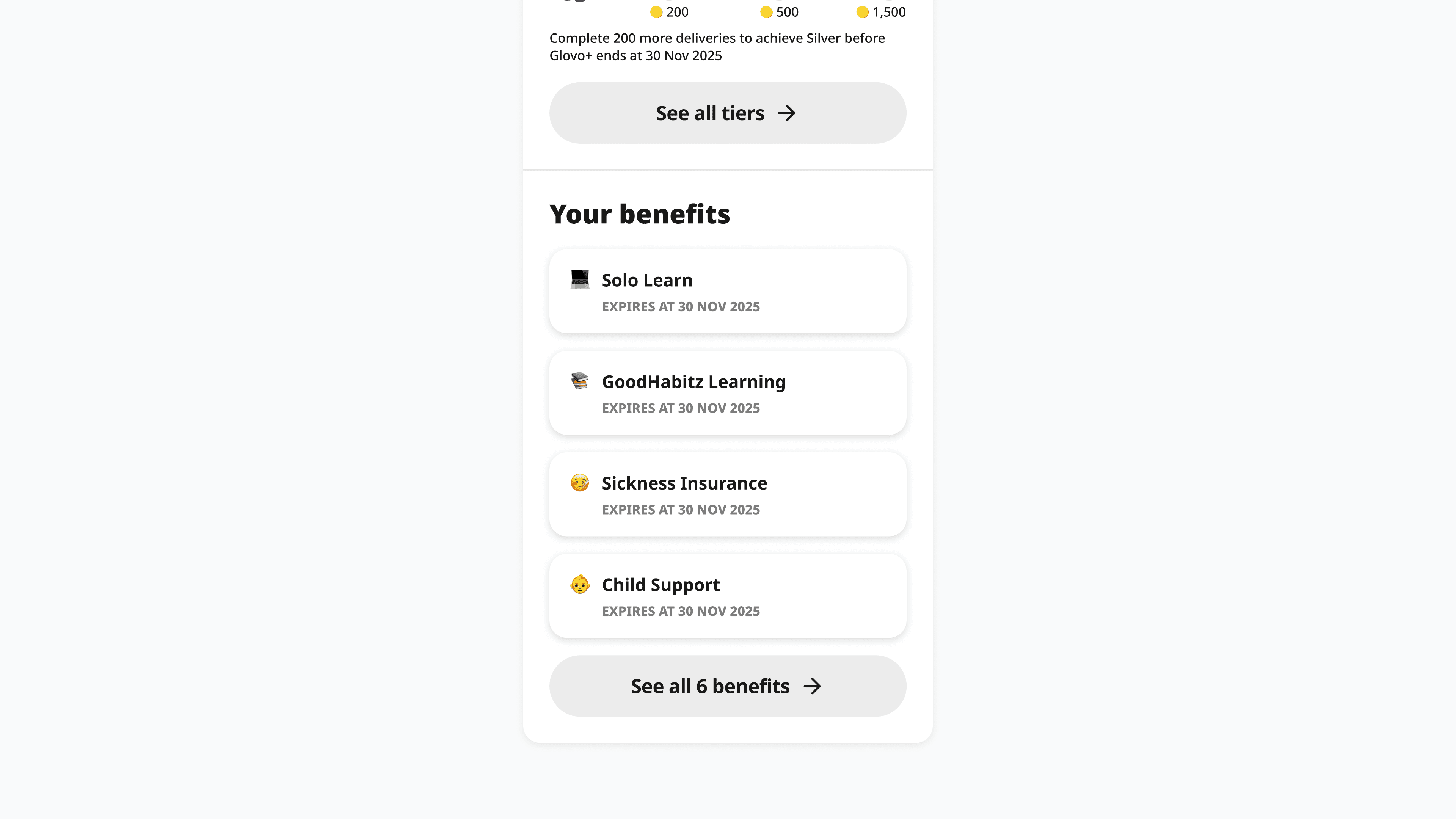
Improved Design
More accessible navigation to show connection between every tiers and the included benefits
Previously in order to see all of the required delivery count and included benefits within upcoming tiers, riders have to navigate back and forth as the entry point is located under each individual cards.
We consolidated and showing it upfront in a single page, allowing riders to scroll through the tiers and what benefits are included
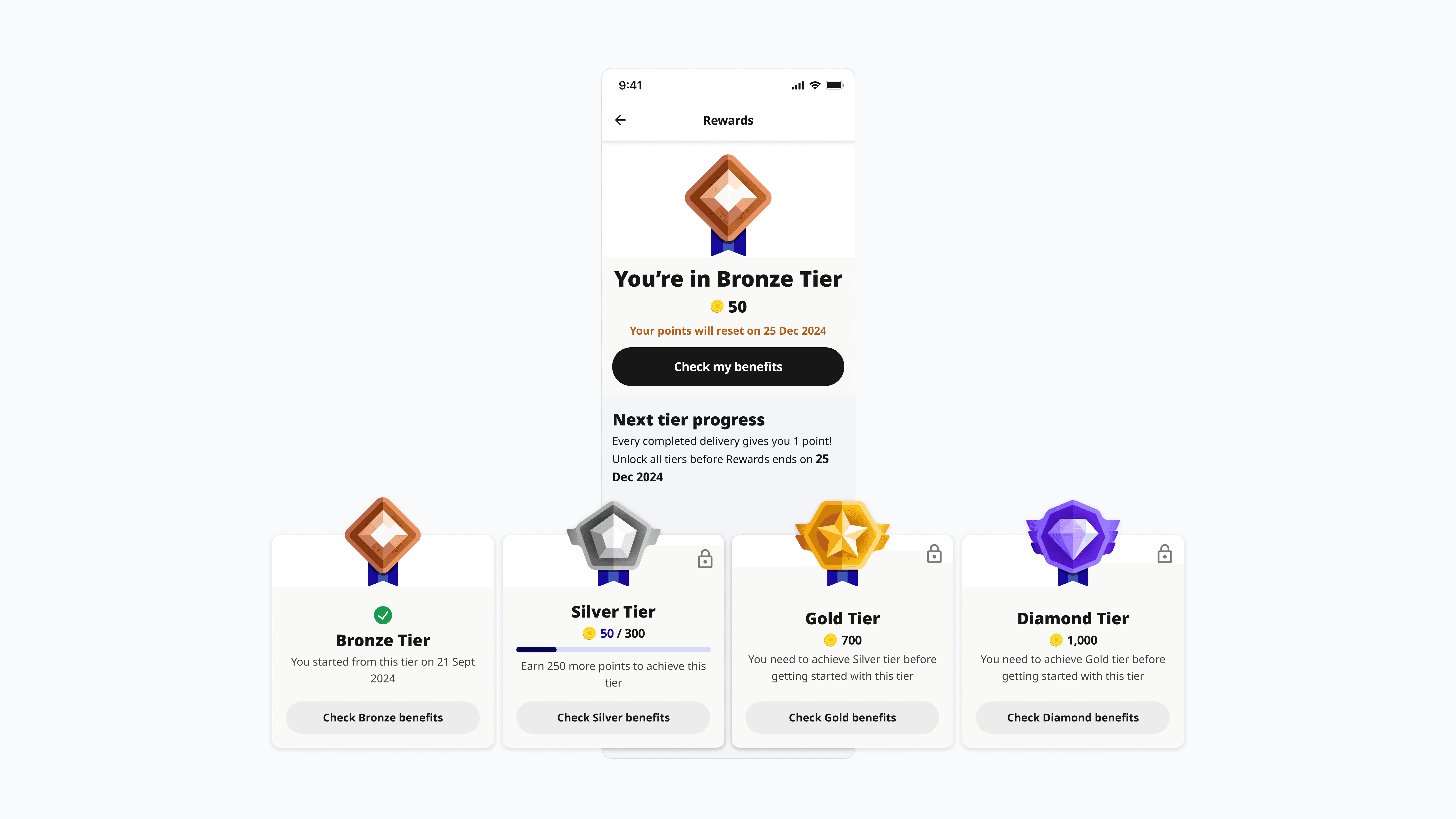
Before (V3)
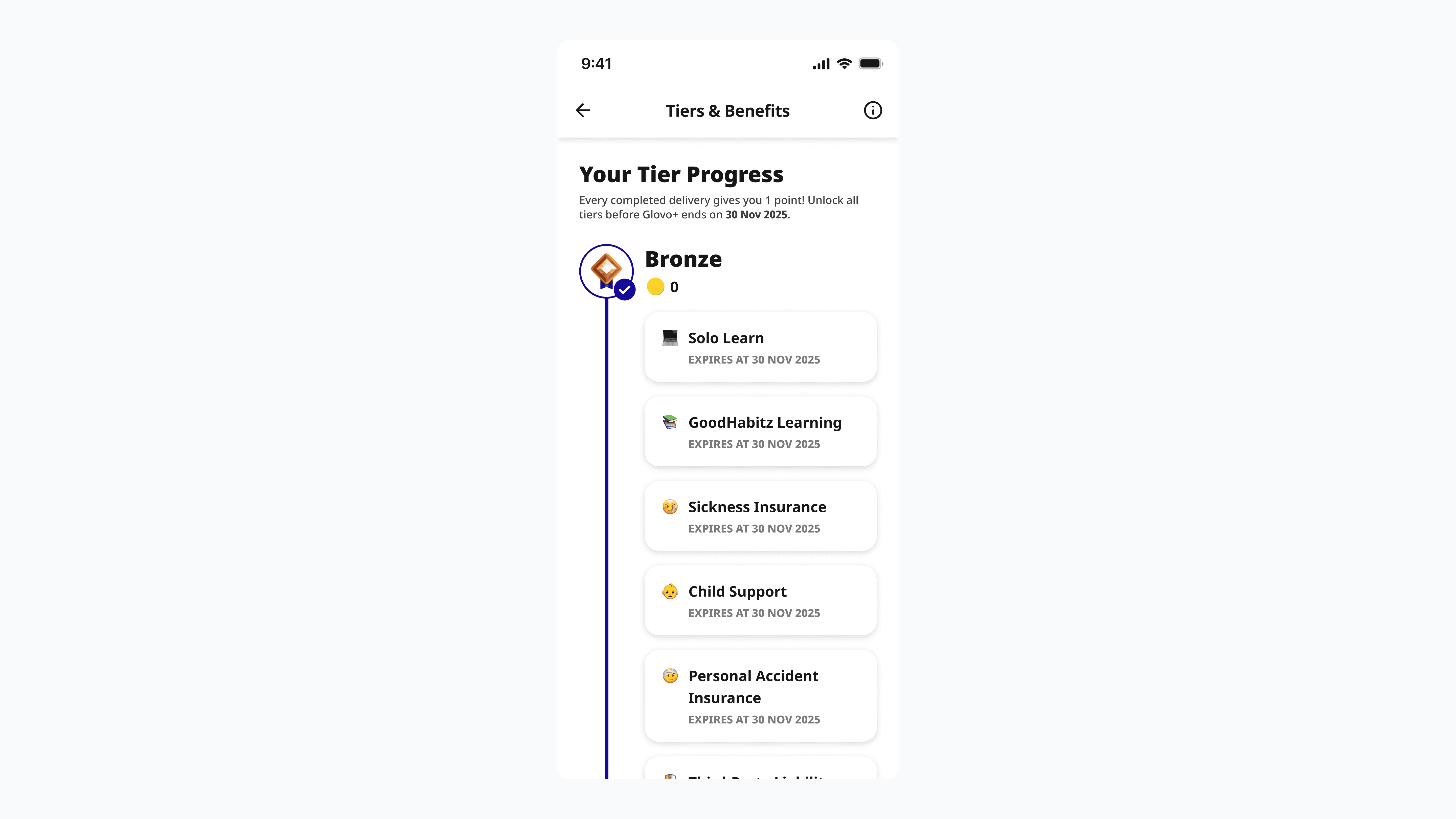
Improved Design
Usability Testing
As the loyalty program is used by riders across many markets, it was important to validate whether the new structure was actually easier to understand for riders.
We ran a structured usability test in Maze with riders from Poland with 11 tasks covering the full loyalty journeys including:
Understanding tier progression
Identifying unlocked benefits
Discovering benefit details
Claiming rewards
Interpreting benefit validity
One of the most interesting outcomes of the test was that many tasks were successfully completed by Riders without any major issues, signaling the new design proposal is strong. But there are still couple of problems worth highlighting to improve:
The new highlighted benefits works, but the layout doesn't
Riders immediately noticed where to find their benefits in the loyalty home page indicating that riders already know where to find their benefits compared to the previous version.
But the entry point to the whole benefit list still lacks visibility / awareness because of it's buried under the entire highlighted benefits. Even after scrolling majority of the riders didn't noticed it.
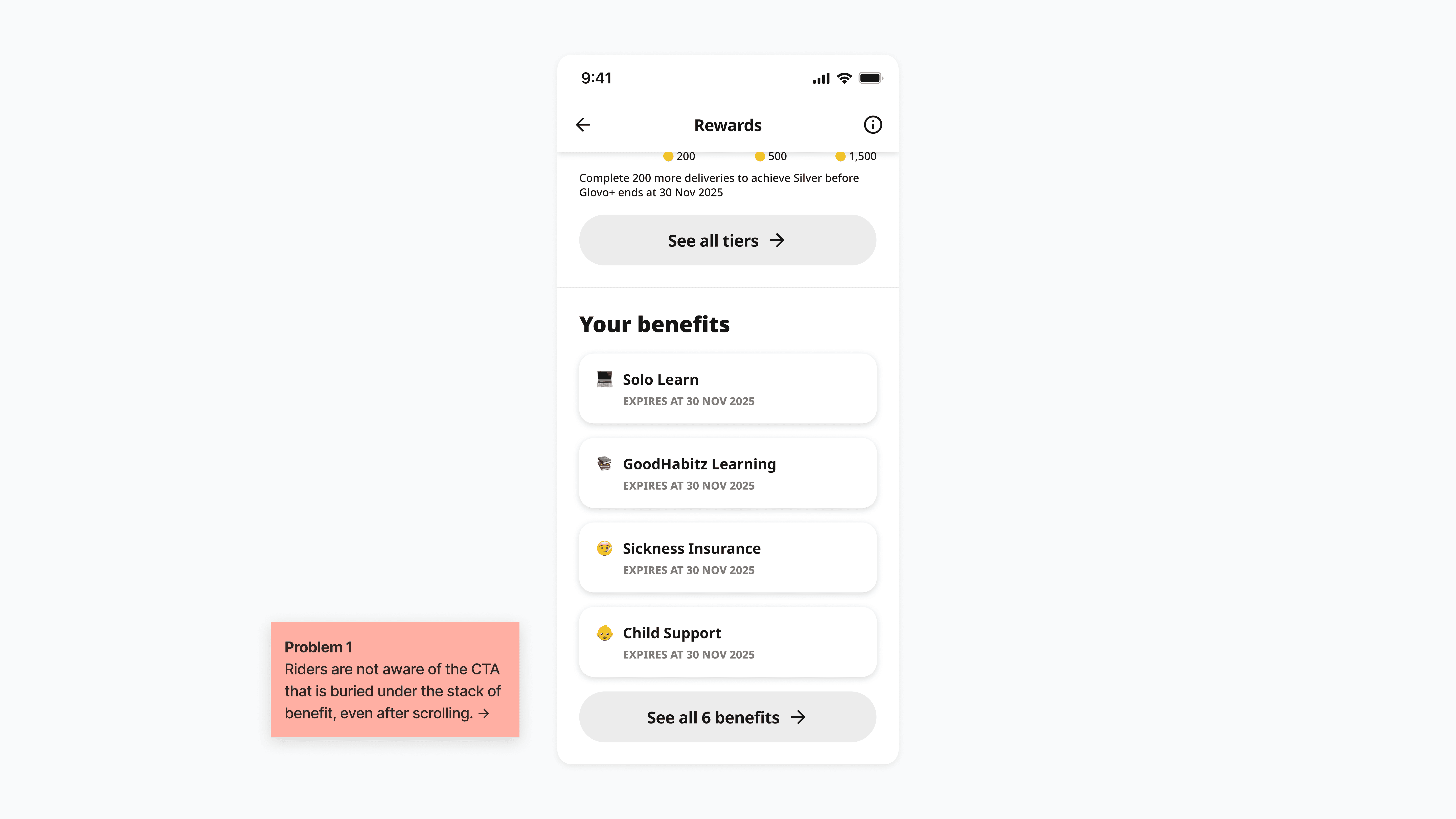
Highlighted Benefits Section in Loyalty Home Page
Tier progression and included benefits become misleading
Riders understood that the progress bar is indicating their progression, but due to how the information is grouped, it misleads riders giving the impression that they have not achieved the benefits yet for the achieved tiers because the progress bar didn't pass through.
Because in reality, once rider achieved a tier rider will immediately unlock the entire benefit from that tier. So the progression mapping is clear, but how the information is grouped and displayed just needs to be improved.
This design was also shown to the regional team and they also had a concern that the list could be very long due to the included benefits, making it a hassle for riders to always have to scroll to find info for upcoming tiers
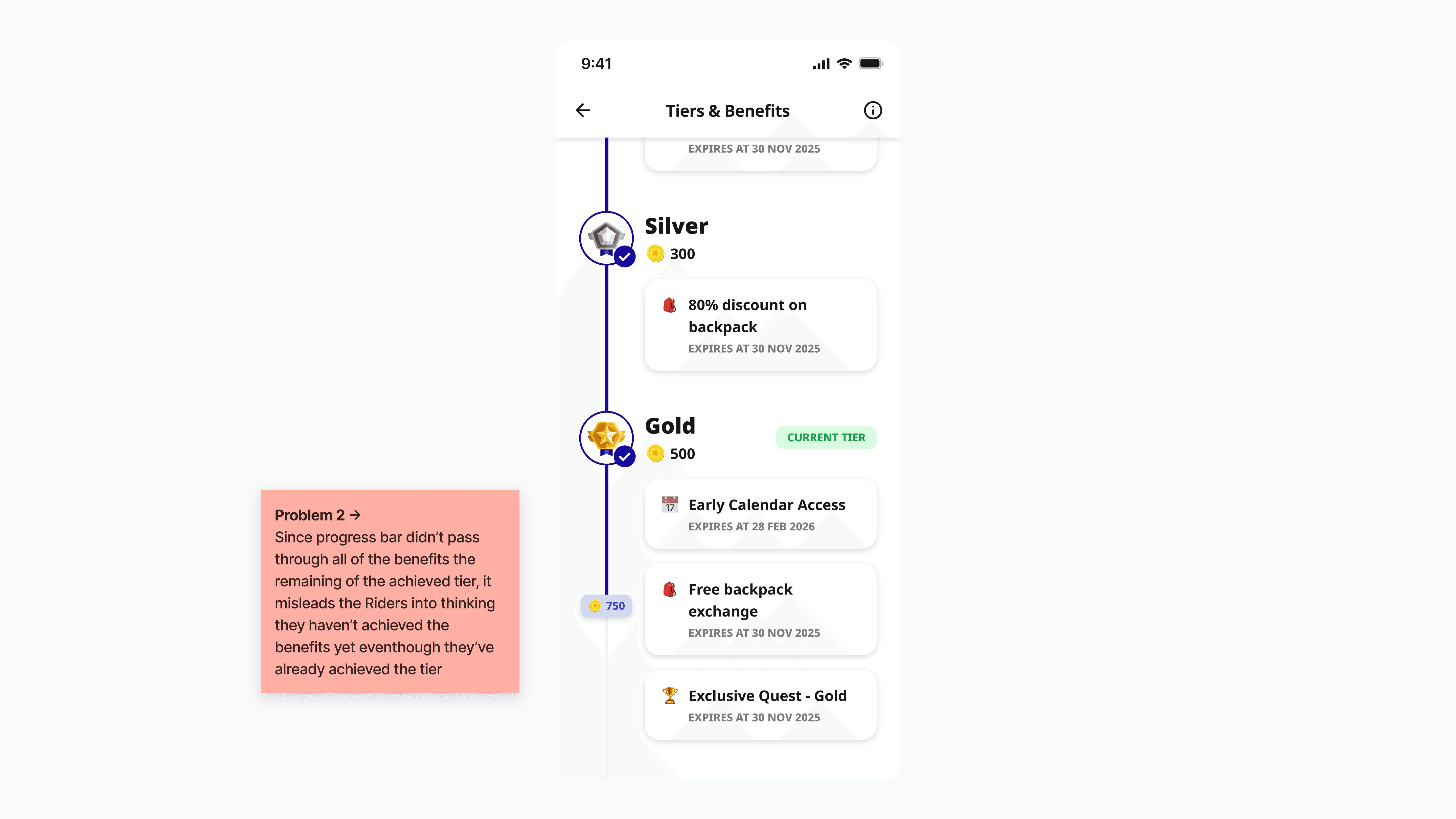
Tier Progress Detail Page
Designing the new experience
With those problems identified from the UT, we further iterated the design to help meet rider's needs.
The Loyalty Home Page
The improved designs immediately answer the three most important rider questions:
Where am I now?
How far am I from the next tier?
What benefits do I currently have?
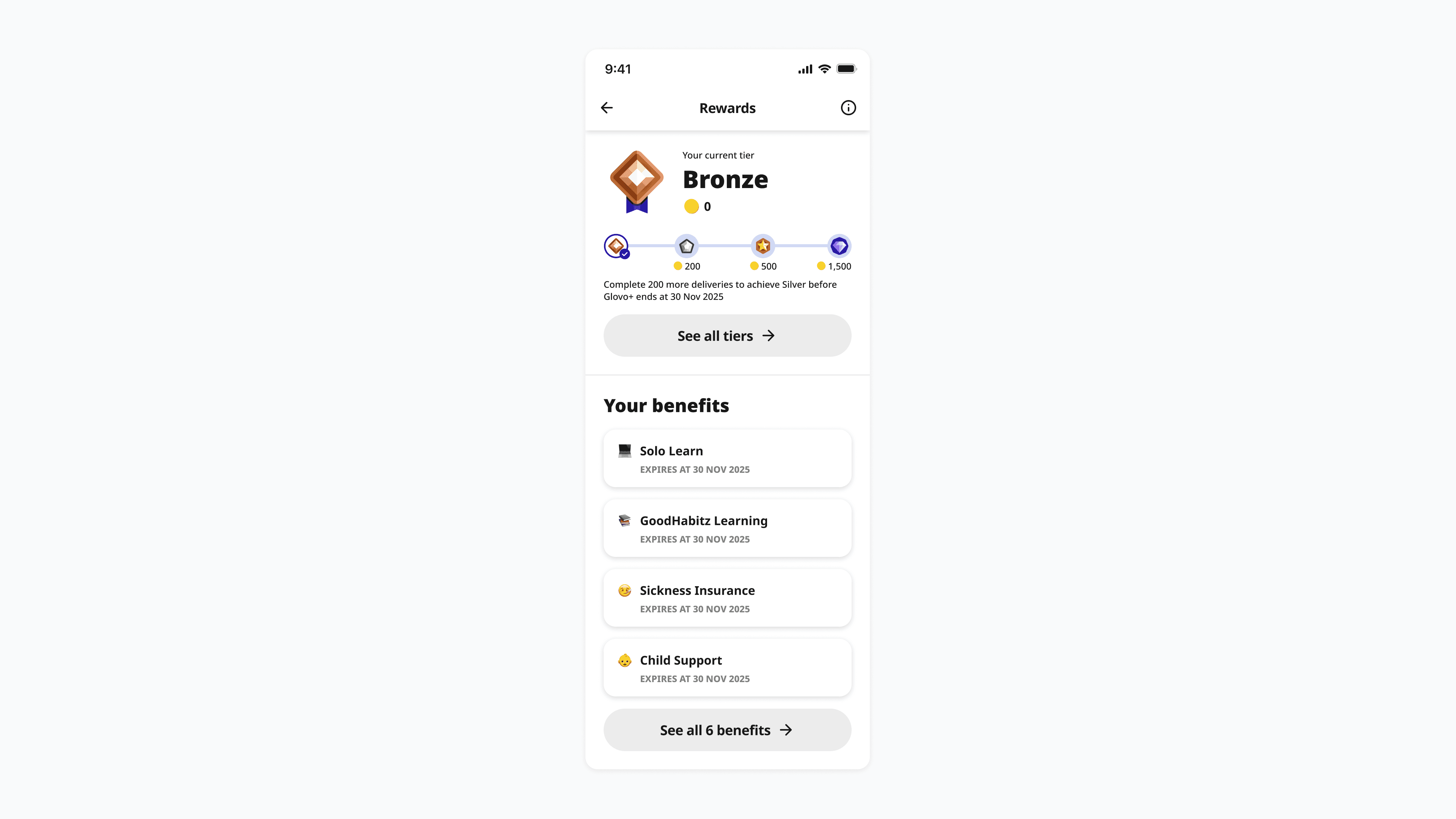
Before UT
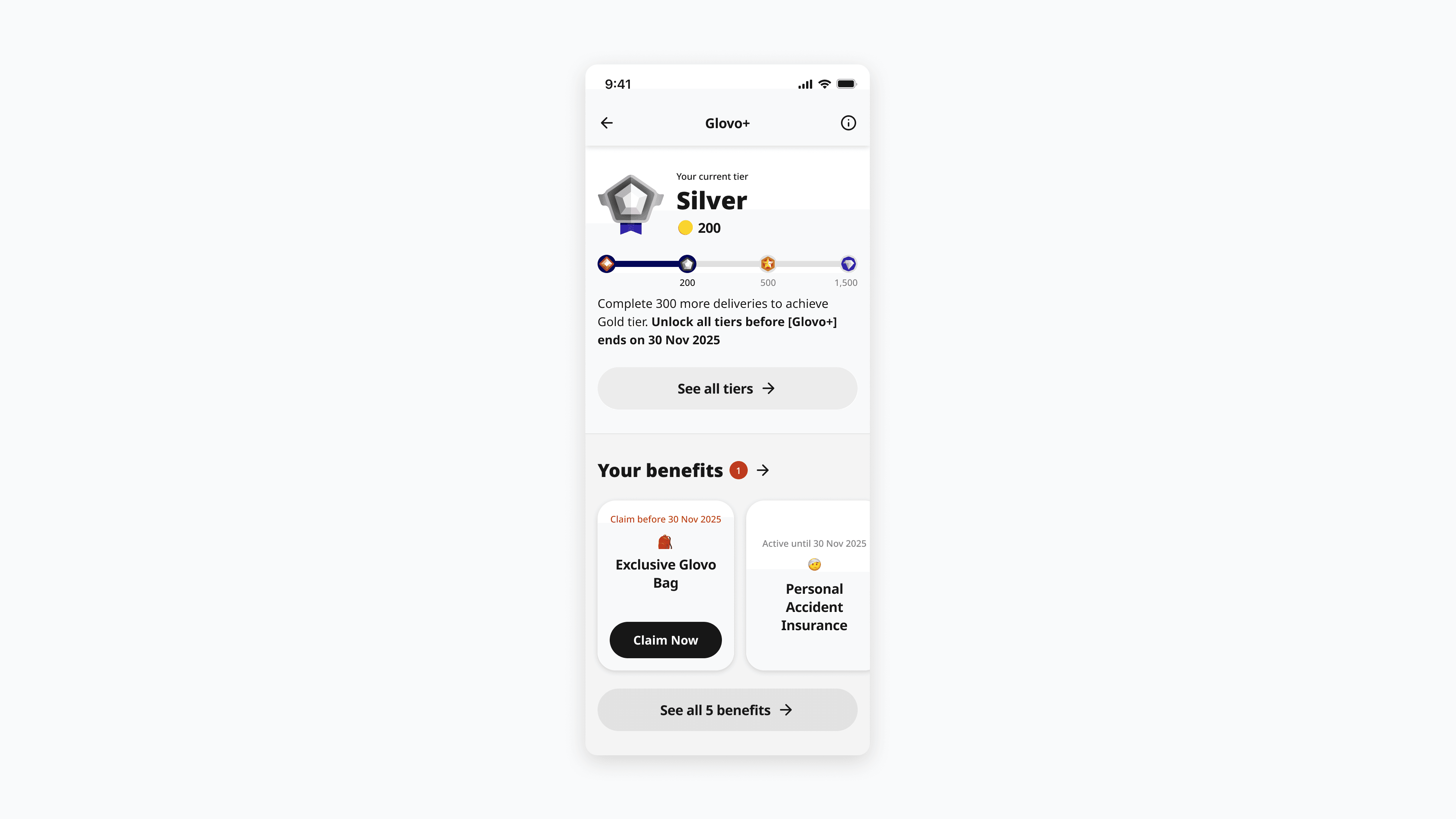
Updated design after UT
Below that, the Your Benefits section shows unlocked benefits in a horizontal scroll layout instead of vertical. This keeps the section compact while making the See All Benefits entry point more visible.
Tier Progress
The previous design used a long vertical list of tiers. In testing, this made riders scroll through a long page and sometimes interpret tiers as sequential rewards rather than distinct levels.
We improved by using the horizontal tier cards approach where each card now clearly represents:
The Tier
Delivery requirements
Included benefits
And tags to indicate the rider's current rider status
This makes tier comparison faster and avoid long vertical scroll.
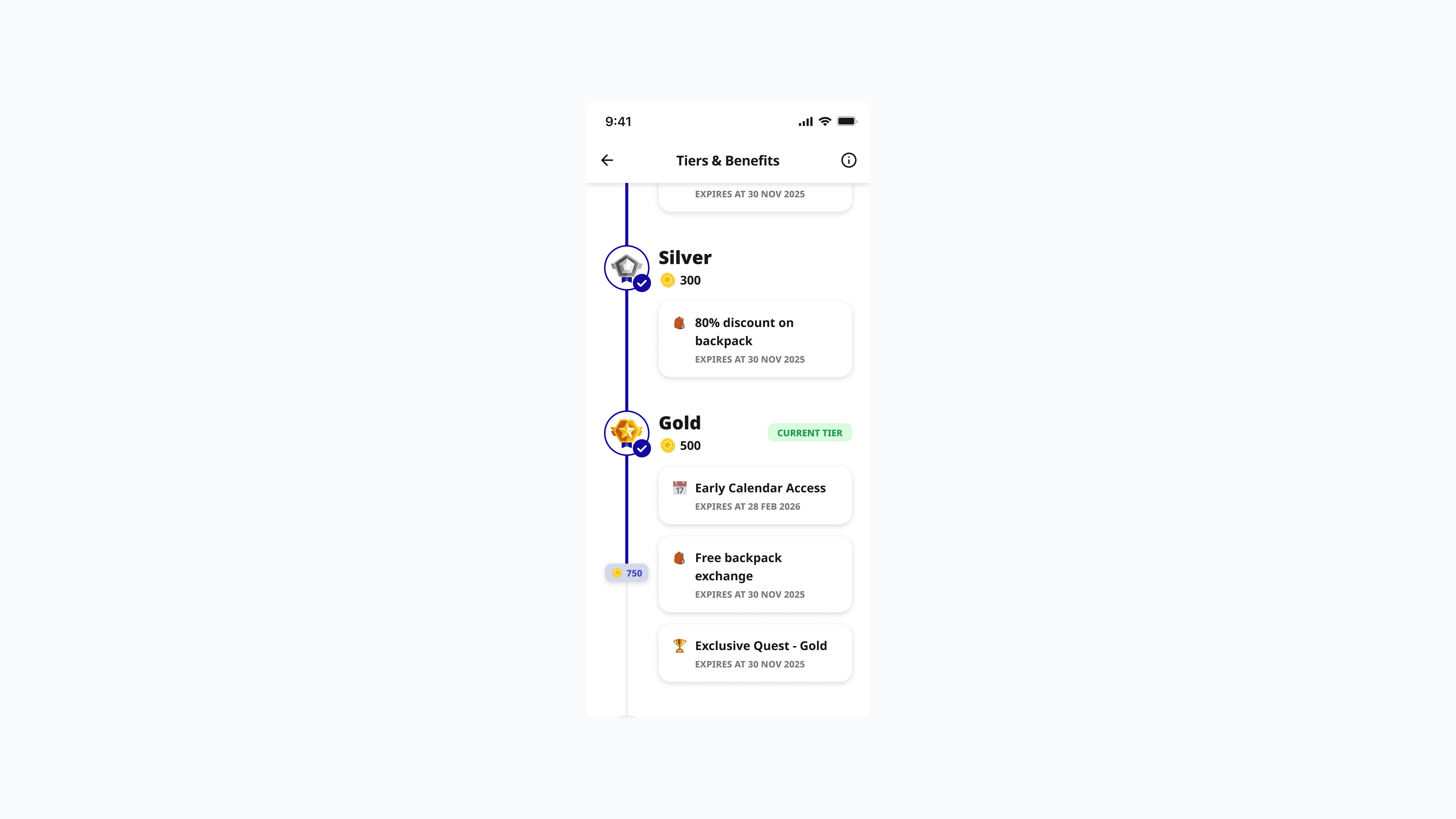
Before UT
Updated design after UT
Benefit List
Usability testing showed that the benefit list itself already worked well. Riders understood that benefit cards were interactive and claim actions were easy to find. But we simplified the visual elements and components shown so that we can fit more benefits in a viewport so that riders don't have to scroll too much to discover their benefits.
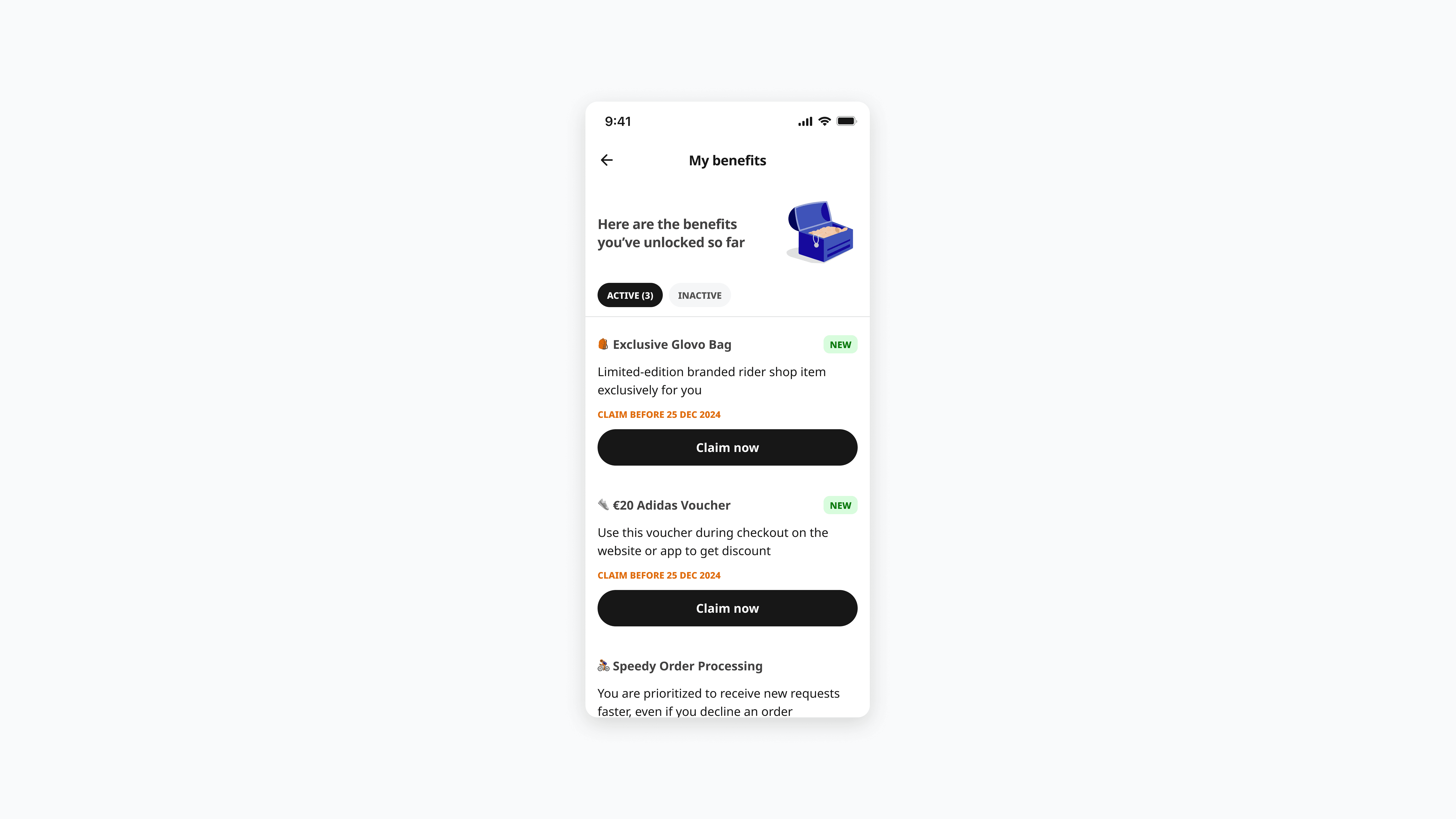
Before UT
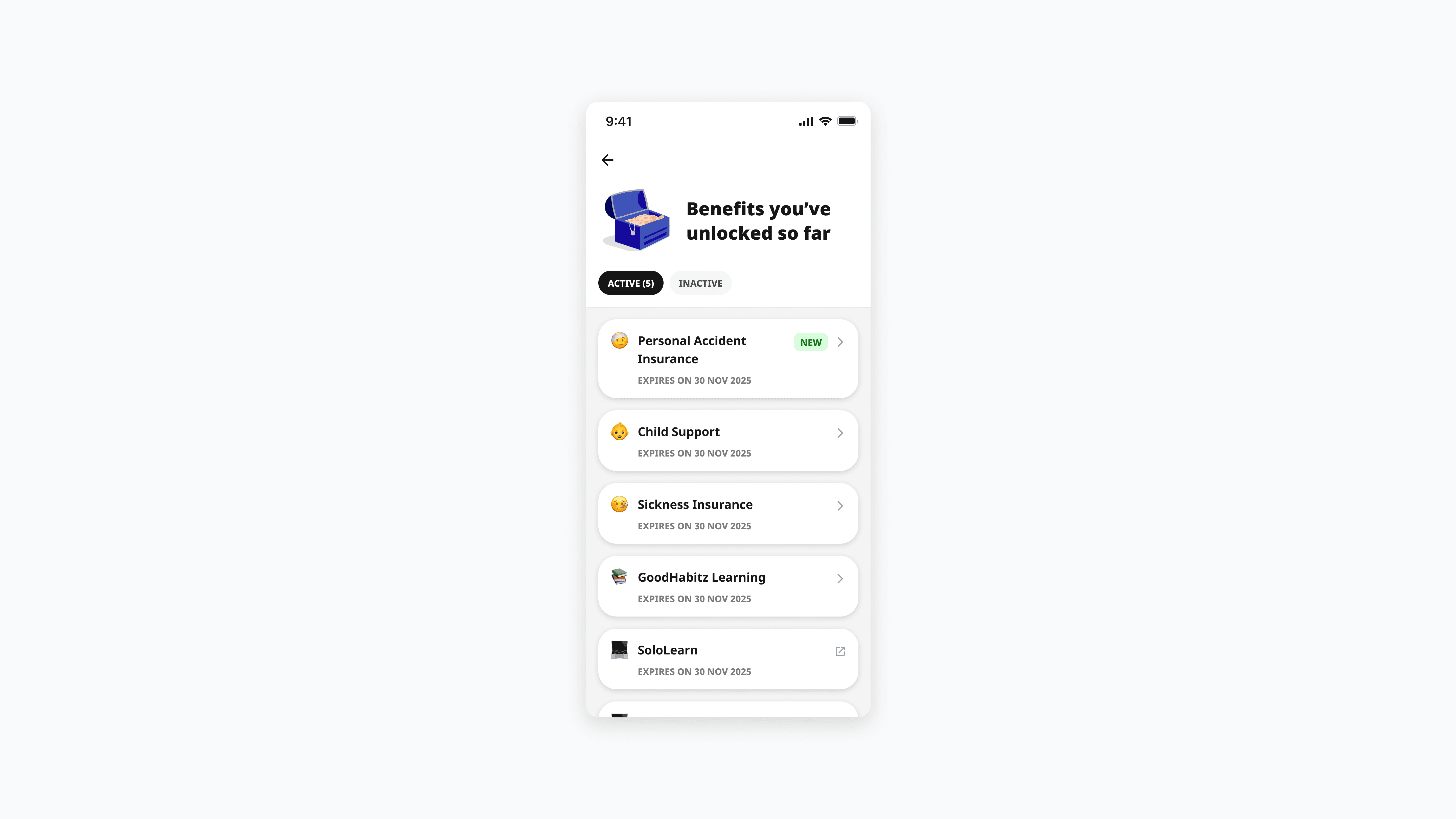
Updated design after UT
Results & Early Signals
Engagement signals after the first loyalty update
Before the full redesign described in this case study, the loyalty experience had already gone through an earlier iteration following the Glovo migration, which is described above as V3. This iteration focused primarily on aligning the interface with Delivery Hero’s design system and resolving smaller usability issues.
After the V3 update was rolled out, we analyzed rider engagement trends across multiple markets using retention datasets. Across the observed markets, the data showed positive retention trends of +54% Average 8W riders retention improvements.
While this analysis was not conducted as a controlled experiment, the results suggested that improvements to the loyalty experience were associated with stronger rider engagement across several regions.
Why a deeper redesign was still needed?
Despite these positive engagement signals, feedback from regional teams and rider research indicated that the experience still had significant clarity issues as explained in the case study above.
This meant that while the program was functioning, the motivational loop of the loyalty system was not as strong as it could be.
The redesign presented in this case study focused on addressing those clarity issues to improve the loyalty program even a stronger asset for retention and motivation.
The Final Redesign
The redesigned loyalty experience has now been implemented and rolled out by engineering. Because the redesign has only recently been implemented, long-term behavioral impact is still being evaluated.